Apropos my previous post on Aristotelian causes in the context of systems theory: The neuroscientist David Marr, in posthumously published Vision, has identified “three levels at which any machine carrying out an information-processing task must be understood.” These are:
- Computational theory. What is the goal of the computation, why is it appropriate, and what is the logic of the strategy by which it can be carried out?
- Representation and algorithm. How can this computational theory be implemented? In particular, what is the representation for the input and output, and what is the algorithm for the transformation?
- Hardware implementation. How can the representation and algorithm be realized physically?
This must have been pointed out elsewhere, because it’s not a terribly original observation, but the first (computational) level corresponds roughly to final and formal causes, the second (algorithmic) level to efficient causes, and the third (hardware) level to material causes. Going along with Mark Wilson, we could say that this correspondence extends the one due to Leibniz, who located final causes at a higher, global level and efficient causes at a lower, local level.
The main point is that, once we recognize that final and formal causes are (largely) system-level properties, whereas efficient and material causes are (largely) component-level properties, a lot of the quasi-mystical aura often surrounding arguments form final causation dissipates. Sunny Auyang expresses this idea with exemplary clarity in her Foundations of Complex-System Theories:
A solid made up of some 10e23 atoms is a causal network whose behaviors are mutually determined with the behaviors of its atomic nodes. How do we assign causes and effects if we insist on talking about causation? An atom causes its neighbors to move in certain ways, but we cannot say it causes the solid to behave in a certain way; an atom is too insignificant to be a cause. We do not say the whole assemblage of atoms causes the solid’s behavior; the structured atomic assemblage is the solid. Micromechanisms for macrobehaviors are causal, but the causes are usually distributed among the atoms or reside in their concerted motions, so that no entity is specifically responsible. If we look at the causal network and want to pick one entity as the cause of something else, chances are our gaze falls on the system; it is the only entity with sufficient significance. An element changes its behavior when it becomes the constituent of a system, and the change is crudely explained in terms of the system’s causal influence or macroconstraint. Some people refer to the system’s influence as “downward causation.”
Downward causation is often accused of being mystical. It is not if it is clearly articulated. There are two dimensions in the interpretation of downward causation, the first regards the effects of the system on the behaviors of its constituents, the second the source of the system’s causal efficacy. Mysticism results if the system’s causal power is credited to independent sources such as vitality or psychic energy that are totally detached from the forces among the constituents and stand above them. Such attribution is not necessary. For us, the system has no independent fund of causal power, although it is described in independent concepts. Whatever causal efficacy the system has is endogenously derived from the self-organization of the constituents. Thus downward causation means no more than the tyranny of the masses. When the strongly coupled constituents of a system organize themselves into certain patterns, any maverick will be pulled back by the others and forced to march in step. Without using the horrible name ‘‘downward causation,” downward causation such as a test particle in a fluid being carried away by the current is common in the sciences. We find it, for instance, in the screened potential of electrons. More familiarly, the intuition that the price structure of the economy downwardly constrains the spending of individual consumers is rigorously represented by the notion of passive price takers in microeconomics.
Authors like Howard Pattee or Alicia Juarrero like to speak of formal and final causes as (global) constraints, which are all system-level properties. For example, the arrangement comprising the controlled system (or the plant, in controlspeak), the controller, the sensors, and the actuators in a negative-feedback configuration is a system-level property. Even more elementary constrained systems, like rigid rods or basic kinematic pairs, which Franz Reuleaux (another one of Mark Wilson’s favorites) introduced as modular building blocks of mechanical machines, are good examples of constraints that operate as formal or final causes over and above the network of efficient and material causes codified in Newton’s particle mechanics.
In fact, the emergence of analytical mechanics through the work of D’Alembert, Lagrange, and Laplace, as well as the introduction of holonomic and nonholonomic constraints by Hertz, can be seen as bringing in formal and final causes without worrying about fully grounding them in the lower-level Newtonian description based on particles and forces. Modern continuum mechanics, which was formalized through the efforts of Clifford Truesdell and Walter Noll, is an instantiation of this, as detailed nicely in Wilson’s Physics Avoidance. Because of the need to account for both classical behavior of rigid bodies and viscoelastic media, as well as for various “nonsmooth” global phenomena (such as shock waves, deformations, and stresses), continuum mechanics looks a great deal like modern control theory, with the notions of inputs, outputs, system state, fading memory, dissipative systems. This synthesis is based on a thoroughgoing conceptual integration of all four of Aristotelian causes, although one always has to remain pragmatic about the choice of the level of analysis, or investigative mood, as appropriate for the context of investigation. Reaching again for one of Mark Wilson’s neat examples, if you are at a pool hall, then it’s perfectly all right to think of billiard balls as rigid bodies undergoing elastic collisions, but if you are a materials scientist, then it’s a whole different story involving flexible bodies or even more complicated objects with lots of microstructure manifesting itself on different scales. It’s causes all the way down and causes all the way up.
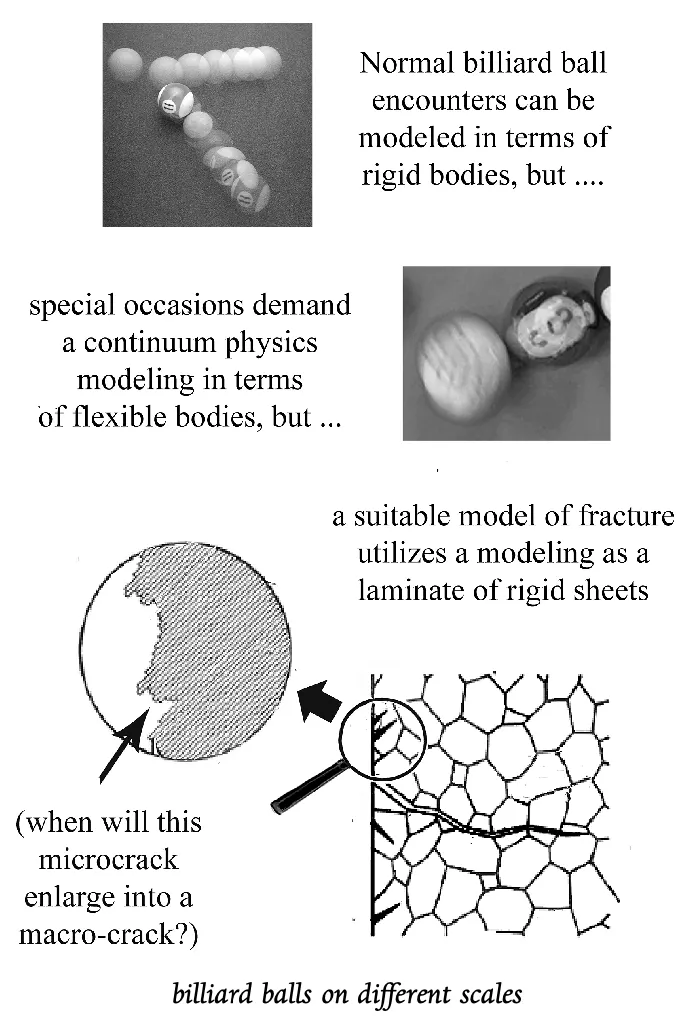
Figure source: M. Wilson, Physics Avoidance, Oxford University Press, 2017.